A First Showcase with Room for Questions
Plan a first showcase that makes live conversation easier, with clear ways to invite questions, set boundaries and decide what feedback to carry forward.
At a first showcase, a visitor may pause beside your work and ask, “What were you trying here?” A useful first showcase gives that conversation room to unfold: visitors can look, ask, listen and respond while you decide what to explain or explore further.
This is less about presenting a complete portfolio than creating a comfortable exchange around work in progress or a developing skill. A simple welcome and a few well-chosen prompts can help people engage without turning the gathering into an examination.
What makes a first showcase feel like a conversation?
Let visitors know how to take part. You might welcome them to look quietly, ask about a decision, or share what caught their attention. This gives people several ways to engage, including those who would rather listen before speaking.
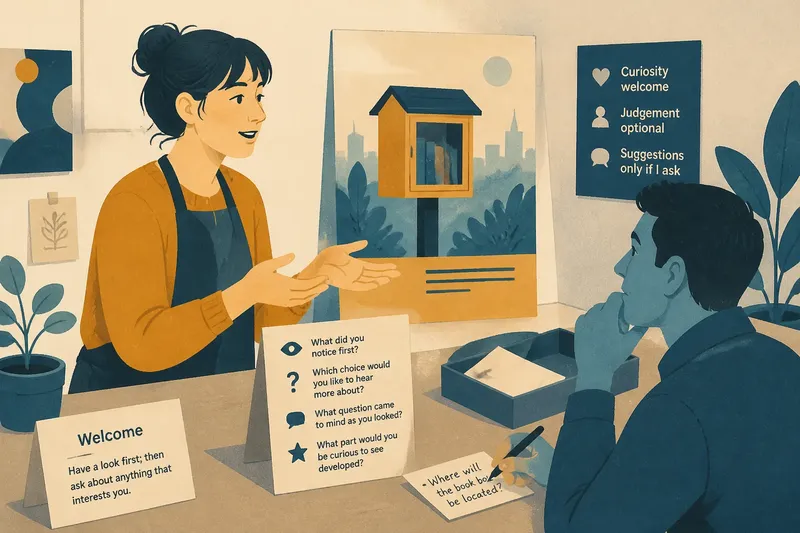
It can help to begin with a short invitation: “Have a look first; then ask about anything that interests you.” That leaves the visitor free to choose a starting point and leaves you free to answer in your own words. You do not need a rehearsed speech for every piece.
Allow a pause after someone arrives. If you fill every quiet moment with explanation, visitors have little chance to form their own questions. A little silence can be part of the exchange, not a sign that it has gone wrong.
How can you invite questions without feeling examined?
Set a conversational tone by asking for curiosity rather than judgement. You could say that questions about your choices are welcome, while comments about what you should do next are best offered only if you ask for suggestions. That distinction makes the kind of response you want easier to understand.
Keep a few prompts nearby for moments when the conversation stalls. A small card can offer visitors a starting point without telling them what to think:
- What did you notice first?
- Which choice would you like to hear more about?
- What question came to mind as you looked?
- What part would you be curious to see developed?
If someone gives advice before asking what you need, you can say, “I’m gathering reactions for now; may I ask what led you to that suggestion?” This acknowledges the visitor while giving you space to consider the comment rather than accept it on the spot.
How can you keep the exchange within comfortable bounds?
A showcase does not require you to discuss every part of your process or personal life. If a question feels too personal, redirect it to the work: “I’d rather talk about the choices in this piece.” You can also say that you do not have an answer yet.
For a group event, agree in advance how people will share speaking time and how visitors can contribute. A spoken question, a written note or a quiet look can all count as participation. If the gathering is online, explain where questions can go and whether you will respond during the session or afterwards.
It is not worth scripting a polished answer to every possible question. A clear welcome, a few prompts and permission to pause are usually more useful than rehearsing a performance.
What helps a live showcase run smoothly?
Match the format to how people need to encounter the work. Printed pages can be laid out on a table; digital work can be opened on a screen; a physical skill may be easier to discuss after a short demonstration. Keep labels readable and place them close to the work, so visitors can look without waiting for you to explain every detail.
Say you are sharing a draft poster for a neighbourhood book exchange, and you want to hear whether the location is easy to spot. You place the draft beside a blank card and welcome visitors with, “Please tell me what you noticed first.” One visitor says the date is clear but asks where the book box will be; you note that question, explain that the location is still being confirmed, and leave the conversation with a specific point to clarify later.
That exchange does not require you to defend the draft or change it immediately. It gives you a live question to consider while allowing the visitor’s response to remain their own.
How should you respond to feedback?
Separate what a visitor noticed from what they suggest you do. An observation might be that a label was hard to read; a question might ask why a particular colour was chosen; a recommendation might be to use a different one. These are different kinds of information, and each calls for a different response.
If you are unsure what someone means, ask which part of the work prompted their comment. You can make a brief note after the conversation, but you do not need to capture every word. Keep your attention on the person in front of you.
Afterwards, review comments when you have some distance from the event. Keep the observations that clarify what visitors saw, consider the questions that reveal something worth exploring, and leave suggestions aside when they do not fit your aims. You remain responsible for deciding what to use.
What do people ask about a first showcase?
What if visitors do not ask questions?
Give them time to look, then offer one open prompt, such as, “What caught your attention?” Some people may prefer to write a question or simply listen, so silence does not mean you need to explain everything.
How do I respond when someone criticises the work?
Ask what detail prompted the reaction, or say that you would like a moment to think about it. You can listen without agreeing, defending the work or deciding on a change during the conversation.
Can visitors give suggestions?
Yes, if suggestions are useful to you, but you can state what kind of response you are seeking before the event. You may thank someone and decide later whether their idea fits your purpose.
What should I do if a question feels too personal?
Set a brief boundary and bring the conversation back to the work, or say you would rather not answer. A welcoming showcase still allows you to choose what you share.
How can you tell whether the conversation helped?
Consider whether visitors had a comfortable way to take part and whether their questions helped you see what they noticed. You might also ask yourself whether you felt able to answer honestly, pause, or set a boundary when needed.
For a practical review, check each observation and decide what to do next:
- Observation: Visitors asked where the work would be used. If that context helps them understand it, then add a short spoken explanation; otherwise, leave the display as it is and keep the conversation open.
- Observation: Several visitors paused at the same label. If they could not read it, then revise its wording or placement; otherwise, ask what made them pause before changing it.
- Observation: A visitor offered a specific improvement. If it fits your aim, then consider trying it in a later draft; otherwise, record the suggestion and keep your current direction.
- Observation: A question brought the discussion away from the work. If you want to continue, then redirect it to a displayed choice; otherwise, politely close that line of conversation.
- Observation: Some visitors contributed only by looking. If you want more responses, then offer a written question card; otherwise, accept quiet attention as a valid way to participate.
- Observation: You felt rushed while answering. If a pause would help, then take one or invite visitors to look while you think; otherwise, give a brief answer and return to the conversation later.
A first showcase with room for questions need not settle what the work means or what you should do next. Its value may be a clearer conversation, a question you want to keep considering, or the confidence to choose your next move on your own terms.
When planning a first showcase, make room not only for visitors to speak but also for you to listen without promising a change. That small distinction helps turn a live exchange into useful input while keeping the direction of your work in your hands.