The Practice Loop: Choose, Try, Notice, Adjust
Use the practice loop to turn a broad skill goal into a focused attempt, useful observation and specific adjustment for your next session.
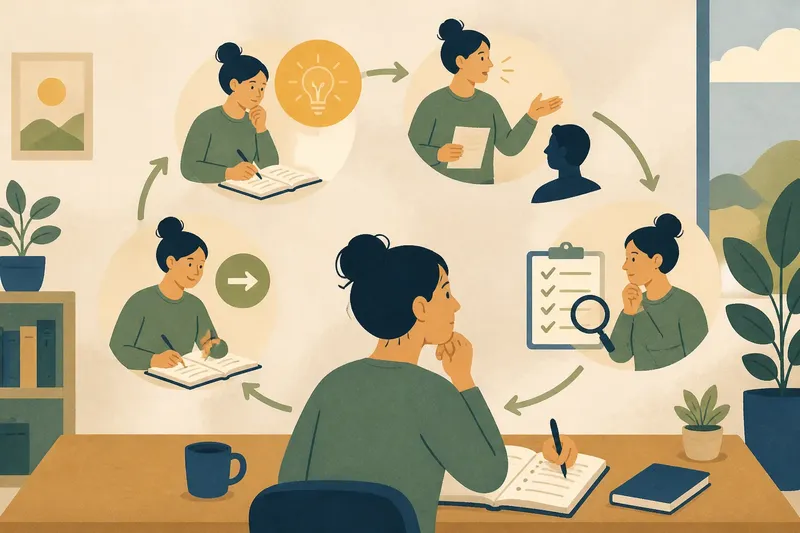
You sit down to practise giving clearer updates, but “be more concise” is too broad to guide what you do next. The practice loop—choose, try, notice, adjust—turns that ambition into one focused attempt and a useful decision for the next one.
The loop suits many kinds of skill-building, from writing and presenting to coding, drawing or learning a language. Its purpose is not to make every session feel successful; it is to make each attempt informative enough to shape what you practise next.
What should you choose for this attempt?
Choose one narrow aim: a behaviour you can try now and notice afterwards. A broad goal such as “get better at explaining ideas” can contain several skills: organising points, choosing examples, speaking at a steady pace and responding to questions. Pick one rather than trying to improve them all at once.
A useful aim names an action and a situation. “State the recommendation before the supporting details in my next project update” gives you something to attempt. “Sound more confident” is less useful because it does not say what to do or what would count as evidence.
Match the size of the aim to the opportunity in front of you. If you have a short practice slot, choose a small slice of the work, such as rewriting one paragraph or rehearsing one explanation. If you have a longer session, you can still keep the learning aim narrow while practising it in a fuller task.
It is not worth writing an elaborate learning plan before every attempt. A brief note that states the behaviour and where you will try it is often enough; spend the effort on the attempt and the observation that follows.
Which situation are you in?
The same loop needs different emphasis depending on what is getting in the way. Use the situation that best describes your current practice, then keep the other parts of the loop simple.
- You cannot tell what to work on: Choose a recent task that felt difficult and identify one moment where the result fell short of your intention. Practise that moment, not the entire skill. This fits when the goal is vague because a specific task gives you something concrete to change.
- You know the skill but avoid using it: Choose a low-pressure setting that still resembles the real task. For instance, rehearse a brief explanation aloud before using the same structure in a team discussion. This fits when hesitation is the obstacle: the aim is a manageable attempt, not a flawless performance.
- You make the attempt but repeat the same result: Narrow the aim further and decide what to notice before you begin. If you keep losing your place while speaking, notice whether your main point is stated before or after the supporting details. This fits when practice feels busy but does not lead to a clear next decision.
- You have received feedback but do not know what to do with it: Translate one comment into a behaviour you can try. “Make the explanation easier to follow” might become “give the conclusion first, then one reason.” This fits when feedback is broad; the adjustment turns it into a practice target without treating one comment as a complete judgement of your ability.
- You are learning something with several moving parts: Choose one element to focus on while keeping the rest of the task familiar. In a short piece of writing, you might work on paragraph openings while using a subject you already know. This fits when changing too many things at once would make it difficult to tell what affected the result.
How do you make a useful attempt?
Set up the attempt so it gives the chosen behaviour a fair chance to appear. Use the materials and conditions that belong to the skill: a blank document for drafting, a sample dataset for a coding exercise, a sketchbook for drawing or a quiet space for practising a spoken explanation. Avoid adding extra difficulty unless it is part of what you intend to practise.
Decide what you will notice before starting. This could be a feature of the work, such as whether a paragraph begins with its main point, or a moment in the process, such as where you pause because you cannot recall a word. Naming the observation in advance helps keep your attention on the aim rather than on a vague verdict about how well you did.
Say you want to improve how you explain a technical change to a colleague. Your narrow aim is to state the effect first, then give the reason. You rehearse a short update using that order and notice that you begin with background information instead; for the next attempt, you write the effect as a cue at the top of your notes. That adjustment follows directly from what happened and gives you a fresh behaviour to try.
What should you notice after trying?
Compare the attempt with the aim, not with an imagined perfect performance. Ask whether the behaviour appeared, what made it easier or harder, and what happened at the point you had decided to watch. The answer might be “I stated the main point, but only after I saw the listener look puzzled.” That is more useful than “I was bad at explaining.”
Separate observation from interpretation. “I changed the sentence three times before finishing it” describes an event; “I cannot write clearly” is a broad conclusion. The first leaves room to adjust the drafting approach, while the second turns one attempt into a claim about your capacity.
Use evidence that fits the task. A draft can be reread for structure; a recorded rehearsal can help you notice where you pause; a coding exercise can be checked against the intended output. If another person offers feedback, ask for a comment tied to the behaviour you are practising, rather than a general rating of your talent.
How specific should the next adjustment be?
Make one adjustment that responds to the observation. It might change the cue you use, the order in which you work, the difficulty of the task or the support available. “Try harder” is not an adjustment because it does not tell you what to do differently.
If the aim appeared but felt awkward, keep it and try it again in a similar task. If it did not appear, make the cue clearer or reduce the task’s complexity. If it appeared but caused a different difficulty, decide whether that new difficulty matters to your larger goal before changing direction.
Do not change every part of the practice setup after one attempt. Keeping the task reasonably similar while changing one feature makes the next observation easier to interpret. That is not a demand to repeat identical work: vary the setting when it is relevant, but know what you are changing and why.
What if the loop seems to stall?
What if I cannot identify an aim?
Start with a recent moment that you can describe, such as losing your place in an explanation or struggling to organise a paragraph. Choose one action that might change that moment, then make an attempt small enough to observe.
What if the attempt goes well?
Notice what you did that helped, then decide whether to repeat it in a similar task or try it in a slightly different setting. A good result is useful information, but it does not require you to raise the difficulty immediately.
What if feedback conflicts with my own observation?
Keep the two observations distinct and check what each refers to. Ask the other person for a specific example, then choose a small attempt that lets you examine the difference without treating either view as a final verdict.
What if I keep adjusting without improving?
Check whether the aim is still relevant and whether your observations are specific enough to guide a change. If the task depends on specialist knowledge or instruction, seek help from a suitable teacher, coach or practitioner rather than cycling through guesses alone.
When should you keep the same aim or change it?
Keep the aim when it remains useful and you are still learning how to carry it out. Repeating an aim can help you notice whether a cue works across different tasks, or whether the behaviour is becoming easier to use without that cue.
Change the aim when the original behaviour is no longer the main obstacle, the task has changed, or repeated observations point to a different skill. For example, once you can put the main point first, your next useful focus might be choosing one supporting detail rather than adding several.
The practice loop is a decision aid, not a fixed schedule or a promise of steady progress. For any skill, the next attempt can simply answer one question: given what I noticed, what is the most useful behaviour to try now? That keeps the practice loop grounded in your work, while leaving room to pause, ask for guidance or choose a different goal when the situation calls for it.