The Myth of the Naturally Gifted Team
The myth of the naturally gifted team hides the habits that make group work dependable: clear roles, shared expectations and complementary contributions.
When a team meeting stalls because everyone assumes someone else will take notes, the problem is not a shortage of talent. It is an unanswered question about responsibility. The myth of the naturally gifted team makes coordination look like a mysterious quality people either possess or lack, when much of it comes from choices a group can make together.
Strong group work does not require identical skills or effortless agreement. It needs people to understand what the work asks of them, what they can rely on from one another and how their different contributions fit. A short routine across a working week can make those conditions visible without turning collaboration into a rigid script.
What does the naturally gifted team myth miss?
The myth treats success as a trait of the group: some teams simply “click”, while others supposedly do not. That view can hide practical causes of friction, such as unclear ownership, unspoken standards or a task that depends on one person to carry every important decision.
Calling a team talented can also make its working arrangements seem fixed. If the group gets stuck, members may blame personality or ability rather than ask whether the brief is clear, whether the workload is balanced or whether a useful skill has been overlooked.
This does not mean that expertise is irrelevant. A group may need particular technical knowledge, judgement or experience; the useful question is how to organise the work around the expertise available, identify gaps early and give each person a meaningful contribution.
How can a team make roles clear?
A role is an area of responsibility, not a rank or a permanent label. “Checks the figures” is more useful than “the detail person”, because it names a task the group can recognise and revisit. Roles may change as the work changes, and one person can hold more than one responsibility if the scope is manageable.
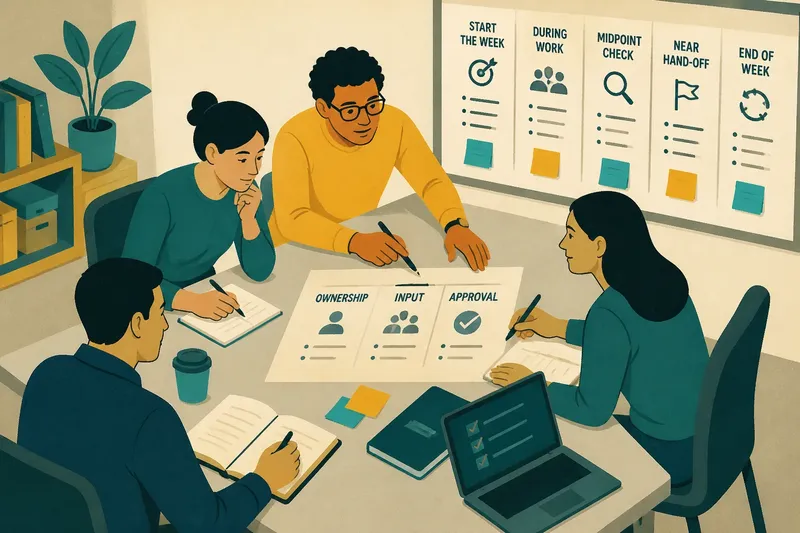
At the start of a piece of work, distinguish three things:
- Ownership: who keeps a task moving and raises a concern if it stalls.
- Input: whose knowledge or perspective should inform the task.
- Approval: who makes or records the final decision.
These distinctions prevent two common snags: everyone contributing to a task but nobody closing it, and one person being treated as the owner of every decision. If the work is shared, say how contributors will combine their input and who will resolve an open question.
Roles should follow the work rather than assumptions about who is naturally organised, confident or creative. Ask people what they can contribute, what they want to develop and what constraints they need the group to know. A person can volunteer for a stretch responsibility while still receiving support, rather than being left to prove themselves alone.
What should shared expectations spell out?
Shared expectations are the team’s working agreements: a common understanding of what “ready”, “done” and “on time” mean for this task. They are most useful when they describe observable actions, not broad wishes such as “communicate well” or “do your best”.
Agree on the practical details that could otherwise be interpreted differently:
- What must the final work contain, and what can remain outside its scope?
- What form should a contribution take: a draft, a recommendation, a checked source or a decision?
- Where will the current version and decisions be recorded?
- How should someone flag a delay, disagreement or missing piece of information?
- What needs review before the group calls the work complete?
Keep the agreement proportionate. A small task may need only a brief conversation and a shared note; a complicated assignment may need separate owners and review points. The aim is not to create a document for its own sake, but to make the next action intelligible to everyone involved.
How can complementary contributions fit together?
Complementary contributions are different kinds of useful input that serve the same outcome. One person may notice what a reader will misunderstand, another may know the technical constraints, and another may be able to turn scattered material into a coherent account. Difference becomes useful when the group makes room for it and connects it to the work.
Do not confuse complementarity with fixed personality categories. A label such as “the ideas person” can quietly exclude someone from shaping the plan or imply that others need not contribute ideas. Instead, describe the contribution needed at a particular point: a reader’s perspective, a feasibility check, a careful edit or a decision about priorities.
Imagine a small team preparing guidance for new volunteers. One member knows the daily tasks, another notices where unfamiliar terms could confuse a newcomer, and a third is comfortable organising the material into a clear sequence. The group agrees that the first member checks accuracy, the second flags unclear language and the third assembles a draft; then all three review whether it serves the agreed purpose. Their contributions differ, but the responsibility for a usable result remains shared.
What can the team do across a working week?
A weekly rhythm gives a group repeated chances to clarify, contribute and adjust. It need not mean daily meetings; use brief exchanges or an existing team check-in where that suits the work.
- At the start of the week: restate the outcome in plain language. Identify the decision-maker, task owners, contributors and any unknowns that could change the plan. Record what “done” means in a place the group already uses.
- During the first work period: ask each owner to name their next visible contribution. Check whether the expected hand-offs make sense: a person cannot review a draft that has not been assembled, for instance. Resolve gaps in responsibility while the tasks are still easy to rearrange.
- At the midpoint: compare progress with the shared expectations, not with guesses about who seems committed. Ask what is ready, what is blocked and what has changed. If one contribution is holding up several others, agree whether to reassign, narrow or reschedule part of the work.
- Near the hand-off or deadline: review the work against the original purpose and the agreed quality checks. Confirm that the right people have had input and that someone has recorded the final decision. Make any outstanding uncertainty visible rather than disguising it as agreement.
- At the end of the week: take a short look at the arrangement itself. Keep what made responsibilities easier to see; revise one agreement that caused confusion. Note a capability the group may want to build or draw on next time, without turning the review into a ranking of people.
The rhythm is a prompt, not a rule. If a project runs longer, repeat the midpoint check when the work changes or a hand-off creates new dependencies. If a task is brief, combine the conversations and keep only the decisions the group needs to act.
What should happen when roles or expectations fail?
When a contribution is late or incomplete, start by locating the mismatch. Was the owner clear? Was the requested output specific? Did another task depend on it? Did someone lack access, context or time? Those questions help the team choose a response that addresses the obstacle instead of assigning a character judgement.
Say you are coordinating a short event plan and the venue details have not been confirmed by the agreed review point. The team checks its note and sees that one person was asked to “look into venues”, with no clear decision or hand-off. It can then name who will contact the venue, what information the group needs and when the answer will be brought back; the observable result should be a decision-ready update rather than another round of assumptions.
If the same ambiguity keeps returning, change the arrangement, not just the wording of a reminder. Split an oversized responsibility, pair someone with a knowledgeable colleague, or make the decision route explicit. Where a person is struggling with the work itself, discuss support and development privately rather than turning a team review into a public assessment.
Which questions help a team notice its patterns?
How do we know whether a role is working?
Look for whether the responsibility has a clear output, an owner and a sensible connection to other tasks. If members cannot say what the role enables or where it hands work on, revise its scope.
What if two people disagree about the standard?
Return to the intended user and purpose, then identify what the work must do before it can be called complete. If the disagreement remains, name who is authorised to decide and record the reason so the group can act consistently.
Can team members change roles during a project?
Yes, when the work or people’s availability changes. Make the hand-over explicit: state what is already done, what remains, where the current material sits and who now owns the next decision.
How can a quieter contribution be recognised?
Do not treat speaking first or most often as a measure of value. Invite written input, ask each person for a specific perspective, and make visible how research, careful checking or thoughtful questions shaped the result.
What is not worth the effort?
A team rarely needs elaborate personality labels, a permanent chart of who is “good at” each task or a meeting for every small decision. These can make people feel boxed in while leaving the actual work unclear. Use the lightest agreement that makes ownership, standards and hand-offs understandable.
The myth of the naturally gifted team is less persuasive when a group can point to the conditions behind its work: clear roles, expectations people interpret in the same way, and contributions that connect rather than compete. When the next task begins, start by making those conditions explicit; the team will have a better basis for noticing both what it can do now and what it can learn to do together.