How a Portfolio Shows More Than One Finished Task
A skill portfolio makes ability easier to assess across tasks by showing relevant evidence, the maker’s role and the decisions behind selected work.
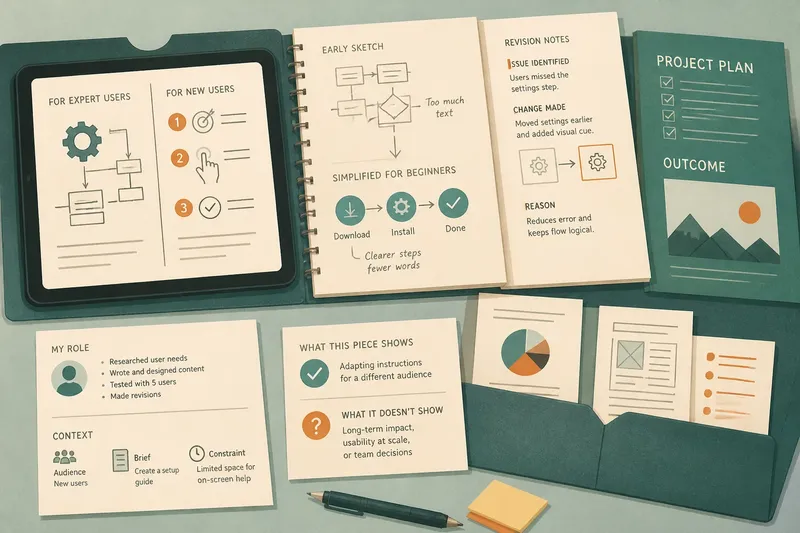
A finished design can show that someone knows how to arrange information, but not whether they can adapt it for a different audience. A skill portfolio lets a viewer compare relevant work and see what each piece can—and cannot—demonstrate.
How does a skill portfolio differ from one finished task?
A finished task is a bounded piece of evidence: a report, repaired object, lesson plan or working model. A viewer can inspect its result, but may have little basis for judging how the maker approached the task or whether the same skill carries across different situations.
A portfolio places selected evidence together. It might be a digital folder of design files, a printed set of lesson materials or a collection of project documents. The purpose is not to display everything someone has done; it is to make a particular ability easier to assess.
The comparison has limits. A portfolio can show variety and decisions that a single result leaves out, but it is an edited selection. The maker chooses what appears, so viewers should distinguish what the work directly shows from what still needs explanation.
What can a skill portfolio reveal?
Related pieces can show how someone adjusts a skill for different needs. A pair of instructions for different audiences, for instance, may reveal whether the writer can change language and structure rather than repeat one format.
A collection can also make a decision visible. An annotated draft beside a final version may show what changed and why, while a project plan alongside its outcome can help a viewer understand how the work was organised. These materials are useful only when their connection to the skill is clear.
Not every capability is visible in an artefact. A polished document cannot establish on its own who made each part, what guidance was available or how the work was used. A short, precise account can clarify those points without asking the viewer to infer them.
How should a skill portfolio make evidence clear?
Begin with the ability the intended viewer needs to assess. Then choose pieces that offer distinct evidence of that ability, rather than several items that all show the same thing.
- Purpose: Check whether each item relates to the stated skill; if it does, keep it, and if it does not, remove it or choose a more relevant piece.
- Direct evidence: Check whether the item lets a viewer inspect the work itself; if it does, include it, and if it does not, replace a claim about ability with an actual artefact or record.
- Maker’s role: Check whether it is clear what the maker contributed; if it is, leave the account concise, and if it is not, add a brief note or select work with clearer authorship.
- Task context: Check whether the audience, brief or constraint affects how the item should be read; if it does, state the relevant context, and if it does not, avoid adding background that distracts.
- Useful contrast: Check whether another item shows a different audience, format or decision; if it does, retain both, and if it does not, remove the repeated item or find evidence that adds a new dimension.
- Readable order: Check whether a viewer can follow the connection between items; if they can, keep the sequence, and if they cannot, add clear titles or rearrange the pieces by task or decision.
It is not worth adding every scrap of work to make a collection appear substantial. Repetition can hide the evidence that matters, and long captions can compete with the artefacts rather than explain them.
How can you choose evidence without overclaiming?
Separate an observation from an interpretation. A viewer may observe that a guide uses short sentences and labelled diagrams; concluding that its maker can communicate effectively to any audience would require broader evidence.
Say you are assembling work to show that you can explain a process to new users. You have a polished guide for experienced colleagues, a rough diagram for beginners and notes showing revisions after a confusing instruction was identified. Keep the guide as evidence of clear presentation, but do not treat it as proof of beginner-friendly writing; include the diagram and revision notes only if they genuinely relate to that audience and your own contribution. If the notes identify what changed and why, a viewer can see the reasoning; if they do not, a short factual caption can clarify the change without claiming an outcome you cannot show.
This approach keeps the portfolio useful without pretending it tells the whole story. If authorship or the conditions of the work remain unclear, say so plainly and leave room for questions.
What do viewers need to ask about a skill portfolio?
What does this piece directly show?
Identify visible qualities, such as structure, accuracy or the way a tool was used. Keep those observations separate from broader claims about ability.
Who made each part of the work?
Clarify individual contributions when an item involved collaborators, templates or substantial guidance. If the division of work is uncertain, treat the piece cautiously rather than attributing it all to one person.
What task or audience shaped the result?
Ask for the brief, intended user or relevant constraint if it changes how the work should be judged. A concise answer can provide context without turning a caption into a project history.
What would make the evidence more convincing?
Look for a complementary item, such as a different format or a draft that reveals a relevant decision. If the collection already answers the question, more material may add little.
How can a portfolio support a fair judgement?
Match the evidence to the ability under consideration. If the question is whether someone can adapt instructions for different readers, work for more than one audience is more informative than several versions aimed at the same reader.
For the person presenting a skill portfolio, useful context is specific: the task, the maker’s role and a decision that affected the result. That makes it easier for a viewer to assess the work on its merits, while keeping open the questions a collection cannot answer by itself.