Solo Repetition or Peer Practice? Pick by the Task
Solo repetition or peer practice? Match practice to the task, so you can focus on difficult moves or uncover gaps by explaining and responding to a peer.
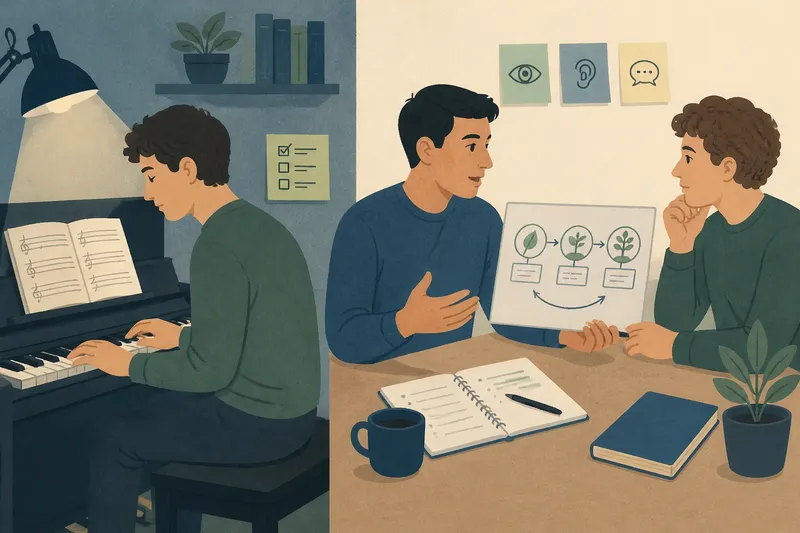
If you can repeat a piano passage accurately but lose your place when someone speaks, solo repetition or peer practice calls for different moments in the work. Choose solo time for a task that needs sustained attention; invite a partner when you need to explain, interpret or respond.
What makes one practice format a better fit?
Start with what the task asks you to do. A clear sequence, precise movement or private attempt often benefits from quiet; explaining a choice, comparing interpretations or answering a question requires another person’s contribution.
Name the difficulty in observable terms. “I need to get better at presenting” is hard to practise; “I need to explain this chart without reading each label aloud” gives a listener something specific to notice.
When does solo repetition help?
Practise alone when conversation would compete with the attention needed to build accuracy or fluency. You might work through a short piano passage, rehearse a presentation opening, or repeat language sounds, then pause to identify where the attempt changed.
Keep the task contained, but do not repeat it on autopilot. Listen for a missed note, a phrase that runs together or a point where the sequence breaks; use that observation to decide what to attempt next.
It is not worth arranging a partner simply to make practice feel more social. If you need quiet to read, recall a sequence or attempt an unfamiliar movement, conversation may add noise without useful information.
When can a peer expose a gap?
A task can feel familiar while its reasoning remains unclear. Someone might copy a spreadsheet formula successfully but struggle to explain which cell references should change when the table is reorganised; a peer’s question can make that gap visible.
Invite a partner when you need to explain a choice, compare interpretations or adapt to another person’s response. Agree on one feature to listen for, such as whether an explanation separates evidence from assumption. The partner need not teach: careful listening and a relevant question can help you notice what you have not yet made clear.
How can you keep peer practice focused?
Replace vague comments such as “that was good” with observations linked to the task. Agree on what the listener should notice, let the learner finish an attempt, and give them room to decide whether a suggestion is useful.
- Listen for the target: If the listener can name one observable feature, such as whether a key term is explained, begin; otherwise, agree on a clearer target before practising.
- Check for interruptions: If comments would break a complex sequence, let the learner finish before responding; if an immediate safety concern arises, stop the attempt and seek appropriate guidance.
- Separate observation from advice: If the listener can describe what they heard or saw, share that observation first; if not, ask them to listen again rather than guess at a correction.
- Give the learner a choice: If a comment relates to the agreed target, the learner can try it on the next attempt; if it does not, set it aside and return to the target.
- Define both roles: If both people have a clear target and turn, switch roles; if one person has no useful task, keep that person listening or practise separately.
- Notice who is leading: If the partner follows the agreed listener’s role, continue; if they take over, restate the roles or return to solo practice.
Say you are preparing to explain a science diagram and already know its labels, but keep stumbling over how the arrows connect the stages. First, rehearse the explanation alone and mark the point where the sequence becomes unclear; then ask a peer to listen specifically for whether each arrow’s meaning is explained; finally, try the explanation again using the listener’s observation. If the peer can follow the connections, keep that wording; if not, revise the unclear link before working on anything else. The decision concerns this explanation, not a general verdict on presentation ability.
Which format suits common learning tasks?
Should I practise a new movement alone?
Begin without a conversation if you need to notice the sequence of a familiar, low-risk movement. If you need correction or the movement could cause harm, seek instruction from a suitably qualified person and follow safe guidance.
Is peer practice useful for learning vocabulary?
Solo recall gives you a chance to retrieve a word without a prompt; a partner can ask you to use it in context. Choose based on the current difficulty: remembering a term and responding in conversation are different tasks.
What should I do if my partner dominates?
Agree on turns and define the listener’s role, such as noting where an explanation becomes hard to follow. If the partner still takes over, return to solo practice or work with someone who can respect the agreed task.
Can I combine solo and peer practice?
Yes, when the task has both an individual and a social demand. Work alone on the part that needs concentration, then practise explaining or responding with a peer and choose the next attempt from what you notice.
How do you decide when to switch formats?
Let the difficulty guide the change. If conversation repeatedly breaks your sequence, remove the audience and practise independently; if solo attempts are smooth but you cannot answer questions or adapt to a different prompt, bring in a listener.
Keep the change modest by altering the format while leaving the task itself familiar. For instance, if you can recite a language phrase but freeze at a follow-up, first rehearse the phrase alone, then answer one peer question using it. If you respond, try another question; if you freeze again, return to the phrase and identify which part needs more attention.
What should you ask before choosing a format?
Do you need quiet to focus on accuracy, sequence or recall? Practise alone. Does the task require you to explain, interpret or adapt to another person? Practise with a peer and agree on one feature to notice.
For solo repetition or peer practice, the useful choice is the one that makes the current difficulty observable. A brief note after the session—what became difficult, what the listener noticed and what the next attempt should address—can help you choose a fitting format next time.